One Architecture, Four Platforms
A multi-agent design is portable; product names are not. Map categories first, then ask of every control feature whether it enforces or only records.
Written as at 19 August 2026.
agentic-aimulti-agent-systemscloud-architectureplatform-engineeringinteroperability
Nothing in the design of Poly’s lesson build names a vendor. It has an orchestrator that plans, five workers with small windows, a task ledger, a tool gateway, an artifact store and one trace per run. Each of those can be built on Anthropic’s Claude platform, AWS, Microsoft Azure or Google Cloud. What changes is the product name on each box, and those names change faster than the architecture does.
So design in categories, map the categories to a platform, and then test whether the products you picked enforce what your design says they enforce.
The categories travel; the product names do not
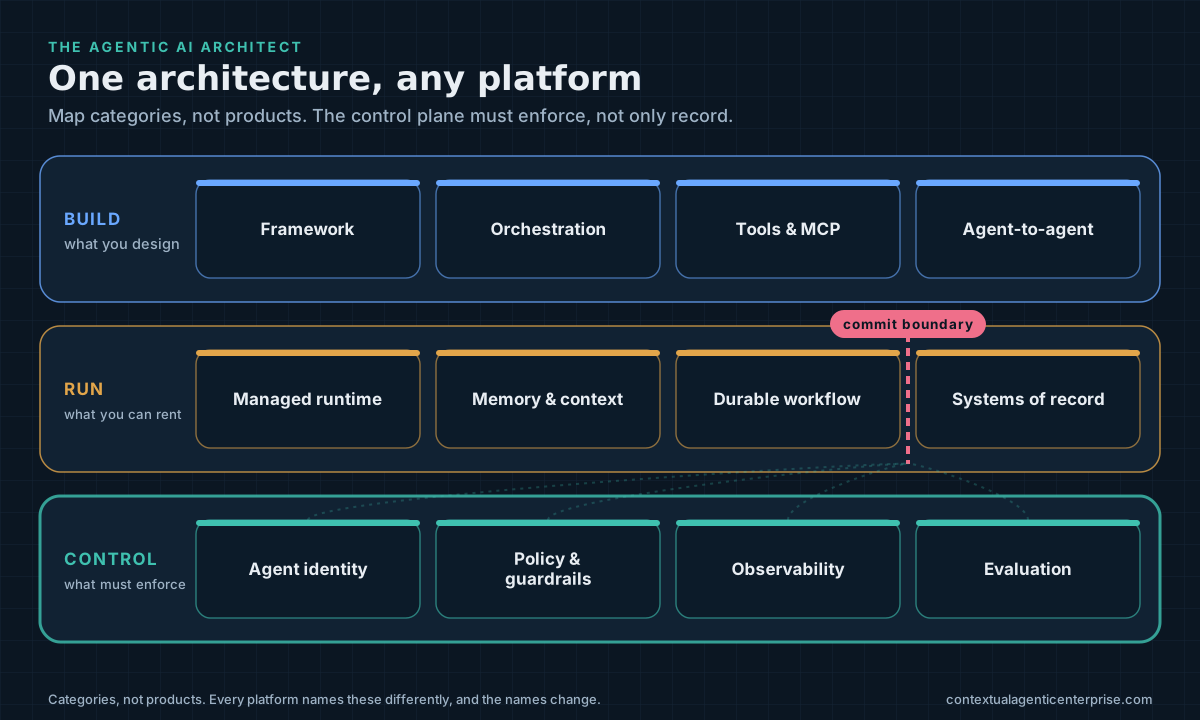
The build plane is what you design wherever it runs: the framework, the orchestration pattern, the tool contracts and how agents talk to other agents. The run plane is what you can rent: a managed runtime with sandboxes, memory and caching, durable workflow, and the systems of record your agents change. The control plane decides whether anything may happen: identity, policy, observability and evaluation.
The control plane is where platforms differ in substance and not only in naming. In my Deterministic Shell / Probabilistic Core model, the model reasons and proposes inside the core, while identity, authority, schemas, state and commitment stay deterministic in the shell around it. The control plane is that shell. Choose the pattern before the platform; the pattern finder walks through that choice.
Ten categories map across four platforms
Read this table as a snapshot, not a recommendation. It lists product names as I recorded them in September 2026 in my working atlas. Names in this space are renamed, merged and retired often, and some entries will be out of date when you read this. Every entry is an example of a category, not an endorsement. Check each one against the vendor’s current documentation before you design on it or study for an exam.
| Category | Claude (Anthropic) | AWS | Microsoft Azure | Google Cloud |
|---|---|---|---|---|
| Build framework | Claude Agent SDK | Strands Agents SDK | Microsoft Agent Framework | Agent Development Kit (ADK) |
| Managed runtime | Claude Managed Agents | Bedrock AgentCore Runtime | Foundry Agent Service | Agent Runtime |
| Multi-agent orchestration | Subagents through the SDK | Bedrock multi-agent collaboration; Strands graphs | Connected agents; Agent Framework workflows | ADK sequential, parallel and loop agents |
| Tools and MCP | MCP, which originated at Anthropic | AgentCore Gateway | MCP through API Management | Agent Gateway; MCP servers |
| Agent-to-agent | A2A through frameworks | A2A on AgentCore Runtime | A2A in Foundry | A2A, which originated at Google |
| Agent identity | Workspaces, API keys; OAuth for MCP | AgentCore Identity; IAM roles | Microsoft Entra Agent ID | IAM service accounts |
| Memory and context | Prompt caching, compaction, memory tool | AgentCore Memory; prompt caching | Foundry memory; prompt caching | Memory Bank; context caching |
| Guardrails and policy | Your classifiers; permission modes | Bedrock Guardrails; AgentCore Policy | Azure AI Content Safety; Prompt Shields | Model Armor |
| Observability | Usage and cost APIs; OpenTelemetry export | AgentCore Observability; CloudWatch | Foundry tracing; Application Insights | Cloud Trace |
| Durable workflow | Bring your own | Step Functions; EventBridge; SQS | Durable Functions; Service Bus | Workflows; Pub/Sub |
Two patterns stand out. The Claude column is thinner in the run and workflow rows, because Anthropic offers a model platform and an SDK rather than a general-purpose cloud, so you bring your own durable workflow. And the protocol rows name the same two standards in every column.
Ask whether each control feature enforces or only records
A feature that records is useful evidence. It is not a control. Put these six questions to every product you place in the control plane.
- Tool policy. Is the decision made on the call path, keyed to the agent’s own identity, the tool and its arguments? At Poly, the researcher must be unable to call
publish, not merely be seen calling it. This is the Authority Envelope, my term for the explicit bounds on what an agent may do: its tools, resources, actions, values, duration and side-effect classes. - Budgets. Can a budget stop a run mid-flight, or does a dashboard report tomorrow what you spent tonight?
- Guardrails. Can a filter block, or only flag? On which paths does it run: user input, tool results, final output?
- Identity. Does each worker get its own identity and short-lived credentials, or do all agents share one service account?
- Durable state. If the orchestrator dies, does the run resume from the last completed task?
- Exit. Are traces exported in a standard form and tools exposed over an open protocol, so you can move without a rewrite?
Questions one to three decide whether your Commit Boundary, my term for the point where a proposal becomes an externally observable effect, is defended on this platform or only drawn on a slide. Delegation Is Not Authority explains why the distinction matters.
Open protocols keep the design portable
Three standards do most of the work of question six. The Model Context Protocol gives agents one way to reach tools and data, whatever framework built them. The Agent2Agent protocol lets independently built agents discover each other through agent cards and exchange tasks, and it is now under the Linux Foundation. OpenTelemetry’s semantic conventions for generative AI give spans common names, such as invoke_agent, chat and execute_tool, and common token attributes, so a trace means the same thing in any backend.
Design to these three and far less of your architecture depends on the platform you choose.
Four certifications test the same design under different names
Four current credentials cover this ground: Anthropic’s Claude Certified Architect – Professional, the AWS Certified Generative AI Developer – Professional (AIP-C01), Microsoft’s AB-100 for agentic AI business solutions architects, and Google Cloud’s Professional Agentic Architect. Their blueprints weight topics differently, but all four test patterns, context, security, evaluation and cost. Use each vendor’s official exam page for domains, prerequisites and status, since these change too. My course is aligned to the topics they cover; it is not official preparation for any of them.
A category map has limits. It cannot choose a platform for you: data residency, existing contracts, your team’s skills and which models are available in your region usually decide more than a feature list. And it goes stale unless someone owns it.
Executives: choose a platform on its control plane and its exit path, not on the demo.
Architects: keep the reference architecture in categories, with a one-page mapping per platform reviewed each quarter.
Engineers: write to the open protocols where you can, and keep the ledger and gateway behind your own interfaces rather than a vendor’s SDK.
This article is part of The Agentic AI Architect, a series from the author of The Contextual Agentic Enterprise. Each piece matches a module of his course in development, Agentic AI Architect Pro.
The interactive version
This article is the argument; the architecture explorer is the worked version. It runs seven layers across the four platforms most often shortlisted, filterable, with each cell linked to the vendor’s own documentation so you can check a coverage judgement rather than take it. Its fourth platform is OpenAI rather than Google Cloud, which is a difference in what the two were written to compare, not a disagreement about the map. Coverage is a reading of the platform as bought, not of what you could build on it, and platform names change often — the page carries the date it was last reviewed for exactly that reason.
References
- The Contextual Agentic Enterprise.
- Model Context Protocol. Specification. https://modelcontextprotocol.io/specification
- Agent2Agent (A2A) Protocol. https://a2a-protocol.org/
- OpenTelemetry. Semantic conventions for generative AI systems. https://opentelemetry.io/docs/specs/semconv/gen-ai/
- Microsoft Learn. Exam AB-100 certification page. https://learn.microsoft.com/en-us/credentials/certifications/exams/ab-100/
- AWS. AWS Certified Generative AI Developer – Professional (AIP-C01) exam guide. https://docs.aws.amazon.com/aws-certification/latest/ai-professional-01/ai-professional-01.html
Related
The Agentic Stack in Three Planes: Where Authority Actually Lives
The popular AI tool maps list a hundred products in two planes: what the agent knows and what it can do. The plane that decides what it may do is usually missing.
Six Trust Boundaries for Multi-Agent Systems
An agent that reads untrusted content will one day be fooled. Security comes from six boundaries enforced in code, so a persuaded model still cannot do harm.
Why Enterprise AI Needs a Deterministic Shell
Don't try to make the model deterministic or simply trust it. Let it propose, and put identity, authority, schema, state and commitment in a shell that decides at the Commit Boundary.